Hattie McCannBBC South West
 BBC
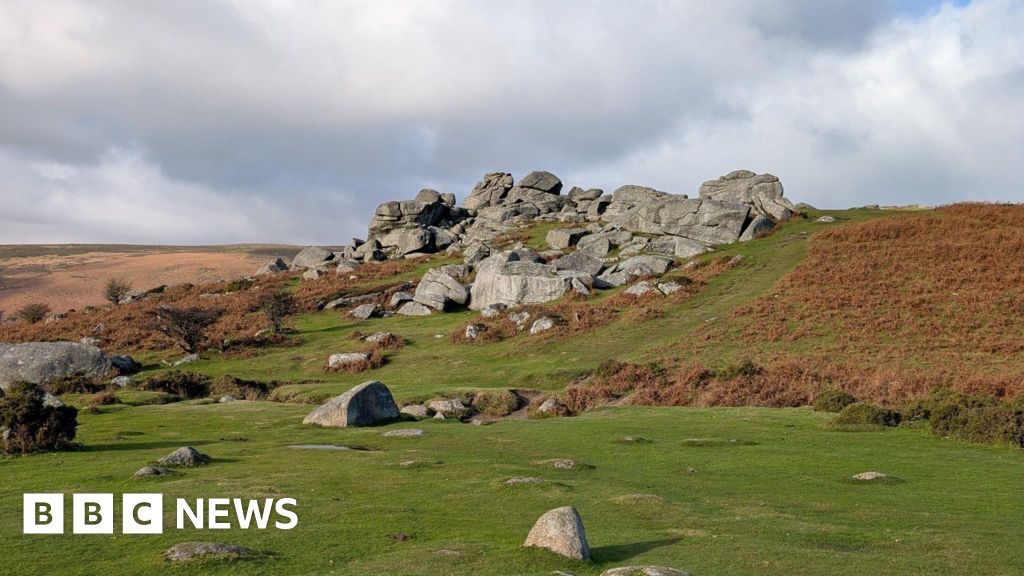
BBCDartmoor marked a milestone year in its history in 2025, with the legal right to wild camp on the moor being upheld by the Supreme Court in May.
The judgement ensured ongoing access and the right to roam to a landscape steeped in myth and legend, that has been a place of inspiration for artists and authors for centuries.
Creatives and cultural experts have been reflecting on how this special access to the moor and the opportunity to experience nature, has influenced work past and present.
Local artist and author, Alex Murdin said: “Just the simple act of going for a walk, can lead to a masterpiece”.

Despite it’s rich history and wildlife, Dartmoor has not always been considered a desirable place to spend time.
Joanne Parker, associate professor at the University of Exeter, said in the late 16th Century, British poet William Canton said “Dartmoor came from dirt-moor” in his most famous work Britannia.
Prof Parker said that in 1820, a poet called Nicholas Carrington from Plymouth wrote a poem trying to counteract this view.
She said that in the preface he writes “Dartmoor is generally imagined to be a region wholly unfit for the purposes of poetry” but writes of “its sublimity and its beauty and the vast expanse of space that you have there”.
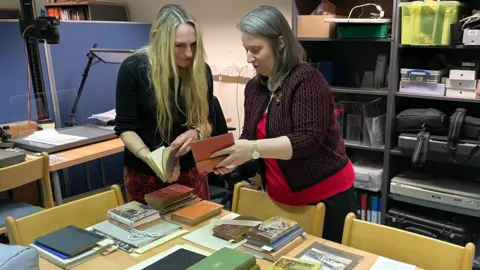
Head of heritage collections at the university, Caroline Walter, said Henry Williamson, author of Tarka the Otter, appealed to Dartmoor to communicate the look he wanted for the illustrated edition of his book.
Ms Walter said: “There’s a really nice little passage here which says: “by the way when you come next, we must hike up to Cranmere and see the tor at Belstone Cleave, your sketch is all wrong””.
In the letter he went on to say it was “far too pastoral for the wild and rugged Tor Marsh”.
Today’s artists continue to try to capture the moor’s rugged essence.
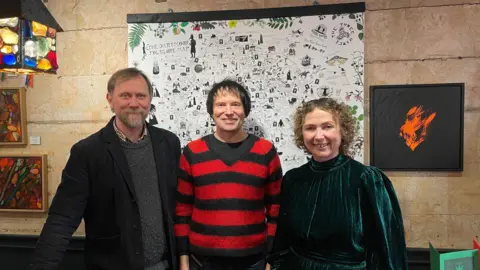
Millie Brown, co-owner of Field System Gallery, said: “There’s something about, I don’t know if you would call it the nature, spirit, or magic, but Dartmoor has a lot of it and people are seeking it out increasingly.”
Her husband Mark Jessett, an artist, agrees: “It’s an extraordinary place in its diversity, woodlands, valleys, rivers, the expansive high moor, colour, alongside the mythology, the magic, the folklore. It’s a very rich source of inspiration.”
Dartmoor’s folklore even inspired those fighting modern legal battles such as that over the right to wild camp on the moor in 2025.
The artist behind the Dartmoor Folklore Map, Ethan Pennell said: “As part of that campaign, the story of Old Crockern, the guardian spirit of the moor, was brought to the fore, so there was that element of ritual.”
“I like the idea that these land spirits are there looking out for us, or maybe not necessarily for us but for the land,” he added.
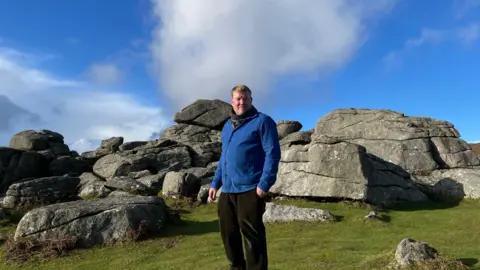
Artist and author of Rock Idols, about the moor’s ancient stone formations, Alex Murdin said the tors and valleys were a major focus of interest.
“There was this massive granite upswelling that took place 280 million years ago which has created a very unique landscape.”
Even the lichen living on the tors roused his curiosity: “It’s actually two species that live together called a symbion, a fungus and an algae coming together to make these extraordinary forms.”
Adding that artists like Leonardo da Vinci used lichens as a source of inspiration in his work, although not ones from Dartmoor.
Mr Murdin said the link between open space and wellbeing interested him.
“There’s a lot of work that psychologists have done to show that walking is a really good way of processing your thoughts and getting inspiration as well”, he said.
“Just the simple act of going for a walk, can lead to a masterpiece”.