
Rebecca RicksBBC South West Investigations
 PA Media
For mariners the waters of the South West have long been a challenging, and historically deadly, coastline. In the days before GPS it was the home of tragedies, disasters and misfortunes with thousands of wrecks now laying undiscovered, plundered or broken at the bottom of the sea. With the knowledge of experts, we examine some of the most notable shipwrecks to come to their end.
HMS Anson, 29 December 1807, Loe Bar, Mounts Bay
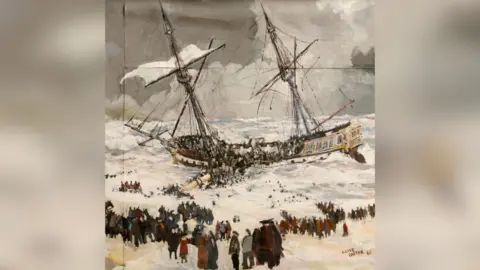
It was a stormy Christmas Eve during the era of the Napoleonic Wars, and the Royal Navy 44 gun frigate HMS Anson departed from Falmouth on what would prove to be its last journey.
The ship sailed into a rising gale on its way to enforce a blockade in Brest.
Turning back to Falmouth in fierce winds could not save the Anson from its fate.
By the afternoon of 29 December, the Man O’ War had wrecked, leading to more than 120 deaths, including two women, two children and the ship’s boy.
Some survivors were able to walk along the mast of the wreck to safety.
Among the dead was Captain Charles Lydiard who was “swept away while trying to save a young boy,” said maritime historian Richard Larn OBE.
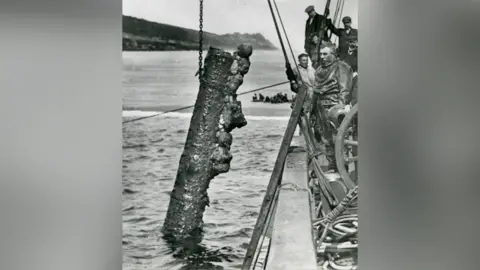
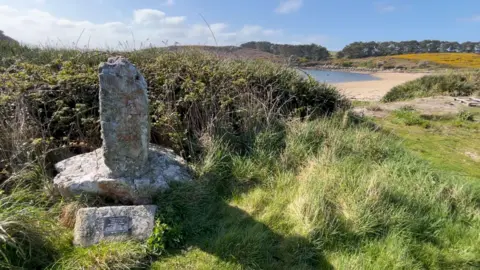
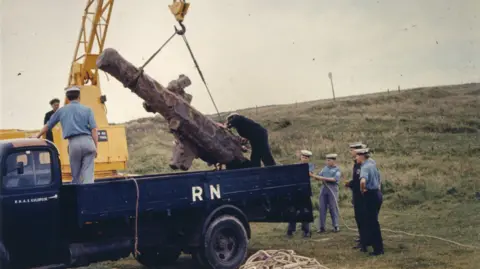
One cannon recovered from the wreck of the Anson can be seen exhibited outside Helston Museum in Cornwall.

 Museum of Cornish Life/Clive Carter
 Museum of Cornish Life
HMS Association, 22 October 1707, Isles of Scilly
Still recognised as one of the worst disasters in British maritime history and dubbed the shipwreck that changed the world.
The wrecking of HMS Association, and three other ships in its fleet, left 1,450 sailors dead but crucially, this tragedy would transform the future of shipping as it lead to two acts of parliament and the establishment of longitude.
“It was the second biggest loss of life in the Royal Navy in one night, which must have been horrible for the people on the Isles of Scilly because think of all those bodies washing up around the off islands,” explained author Richard Larn OBE, who himself has an encyclopedic knowledge of shipwrecks.
Mr Larn said the ship wrecked due to navigational errors, created by the inability of seafarers to calculate longitude meaning ships often ended up wildly off course.
HMS Association was the flagship of Sir Cloudesley Shovell, who had worked his way up from lowly cabin boy to become Admiral of the Fleet in 1705.
Queen Anne and the government gave a £20,000 prize to carpenter, John Harrison, who after years of commitment, came up with a chronometer that did calculate the elusive longitude.
Its wreck was found by a team with Mr Larn in 1967.
HMS Colossus, 10 December 1798, Samson, Isles of Scilly
“She was carrying Lord William Hamilton’s cargo of ancient Dutch, ancient Greek vases, and pottery,” explained Mr Larn.
“Lord Hamilton was the husband of Emma and Emma was Nelson’s bit on the side.”
The cargo was intended for display at the British Museum.
But one night, at anchor, HMS Colossus was caught by a gale and dragged, “fell over on her beam and was lost”.

A lot of the cargo was lost, but some of it floated out in crates.
Lord Hamilton was said to have been less than impressed the navy managed to save the embalmed body of Admiral Shuldham, but not his priceless collection.
The museum, Mr Larn said, funded the recovery of much of the pottery, through Penzance salvor Roland Morris.
The ship’s cannon now feature on the quay of St Mary’s harbour as bollards.
HMS Coronation, 3 September 1691, Rame Head, Plymouth
“We know it was a terrible storm and we know over 600 died on the wreck… it was said at the time that the screams of the sailors could be heard on the coast,” explained wreck license holder, Mark Pearce.
The warship sank near Penlee Point although exactly why it sank is still unknown.
It is believed about 20 of its crew survived.
The wreck is a popular diving site and individuals have since recovered a number of artefacts including plates and the ship’s bell.
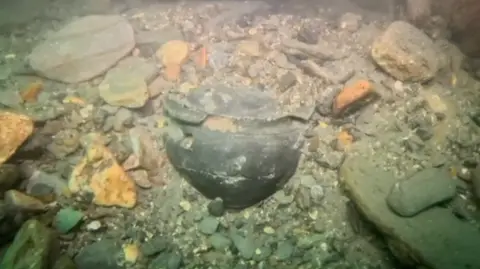
In May, divers found a pewter chamber pot described as “really rare”.
Mr Pearce, who has been diving HMS Coronation for 15 years, said: “As a diver your dream is to find a bell, but bells are very common compared with a chamber pot, something which was personal to the captain.”
 Mark Pearce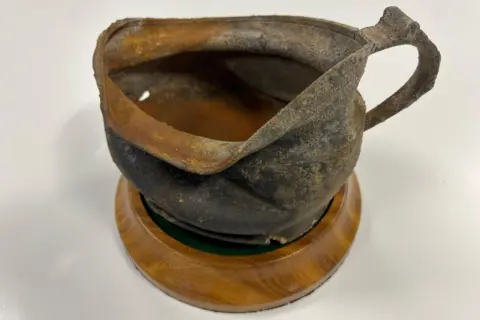
Aeolian Sky, 4 November 1979, Portland Bill 12 miles off
The one-year-old cargo ship initially collided with MV Anna Knuppel close to Guernsey on 3 November 1979.
A French tugboat began towing the ship in the hope they would make it to Portland but it fell short as the Aeolian Sky began sinking by the bow.
Land Rovers, two diesel electric locomotives, chemical cleaning products and nail varnishes sank with the vessel.
A reported £4m in Seychelles Rupees, which were later cancelled by The Seychelles government, were also onboard – some of the notes were reported as being hauled up years after in local lobster pots.
 Museum of Cornish Life
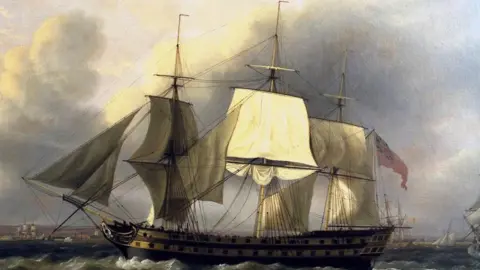
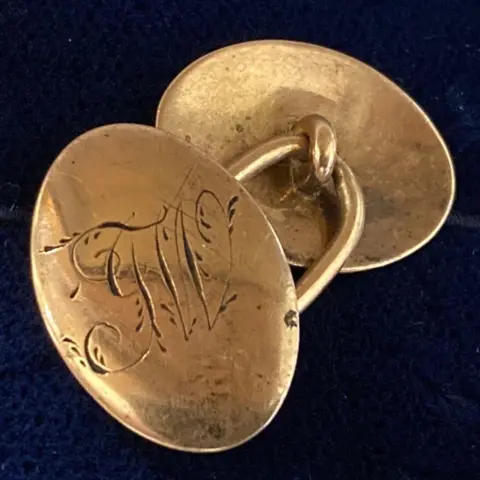
Earl of Abergavenny, 5 February 1805, Weymouth Bay
“The captain of the ship was John Wordsworth, who was William Wordsworth’s brother,” Beccy Austin who works in marine archeology, explains.
It was said he spent a life at sea to support his brother’s writing career.
“Sadly, he did die when it sank along with 250 other people and it’s said that his death affected Wordsworth so much, you can actually see the change in his writing over that time.”
 Portland Museum Trust/PA Wire
The ship sank when a combination of stormy weather and human error saw it hit a sandbank causing an irreparable leak.
It carried a cargo valued at £200,000 – worth more then £15m in 2025.
In 2024 the wreck was granted ‘protected status’ meaning divers could look but not take artefacts from what is left of the ship.
 Portland Museum
The Hollandia, 13 July 1743, Broad Sound, Isles of Scilly
The Hollandia was on its maiden voyage to the Far East when it sank at Broad Sound after it was believed to have hit Gunner Rock.
It was reported 246 crew and 30 passengers on board died.
An initial search for the wreck was unsuccessful, but later in 1971, it was found using a vessel that was towing a magnetometer.
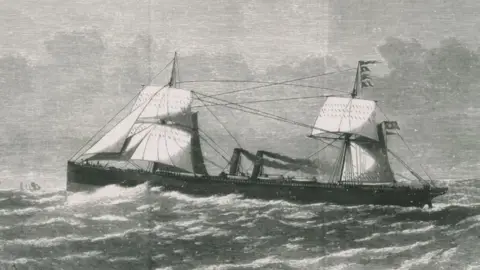
SS Schiller, 7 May 1875, Western Rocks, Isles of Scilly
Often referred to as the Victorian Titanic the luxury liner had left New York bound for Hamburg when it encountered dense fog as it reached Scilly.
“A bottle of champagne was promised to the first crewman or passenger who heard or saw the Bishop light or fog horn”, Mr Larn explained.
But the champagne incentive could not save the ship as it struck the Retarrier Ledges near the lighthouse, killing 311 people.
Only two of her eight lifeboats were able to get away with rough seas sweeping many of those onboard to their deaths including about 50 children.
Many of those who died in the tragedy were laid to rest in two mass graves at Old Town Church in St Mary’s.
Nearly all of the $300,000 of gold coins the ship carried have since been recovered.
 Scilly Arts and Heritage
St Anthony, 19 January 1526, Gunwalloe, The Lizard
A Flemish carrack ship, it carried a variety of cargo including barbers basins, linen and even horse harnesses for King Henry VIII.
Described as a “fine ship” it came ashore due to bad weather, 42 said to have died in the disaster.
Its wreck is well documented after survivors accused three Cornish magistrates, accompanied by 40 local servants, of robbery and the case went to court.
The wreck was located by Mr Larn in 1981.
SS Mohegan, 14 October 1898, the Manacles, Falmouth
The liner, which hit the Outer Manacles, had eight lifeboats but it was another to only get two of them away – one of which then capsized.
The Porthoustock lifeboat attended the wreck saving any lives it could but 106 still perished. Mr Larn wrote in his book that, “not one deck officer survived to explain the accident”.
The bodies were buried in a mass grave at St Keverne.
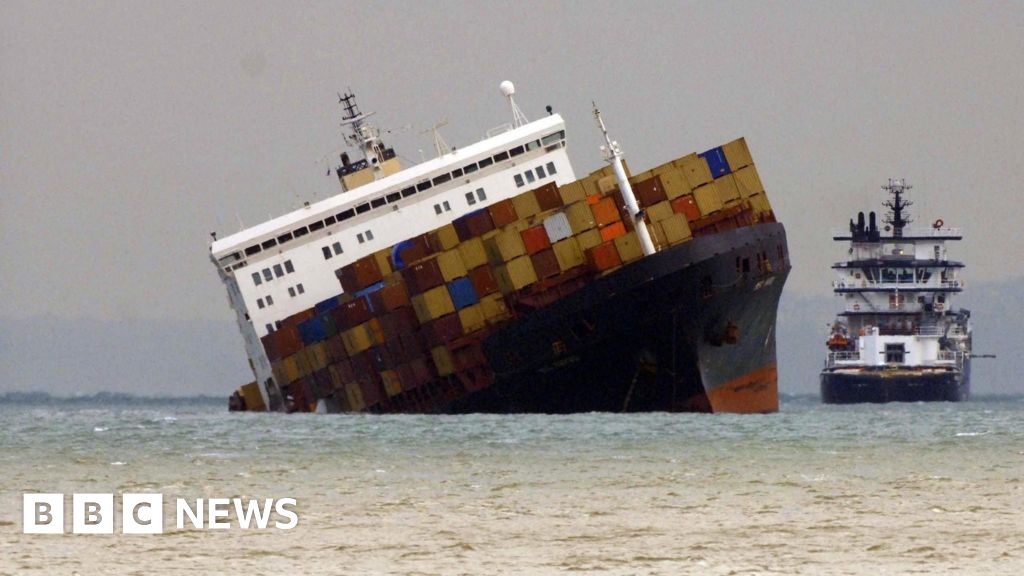
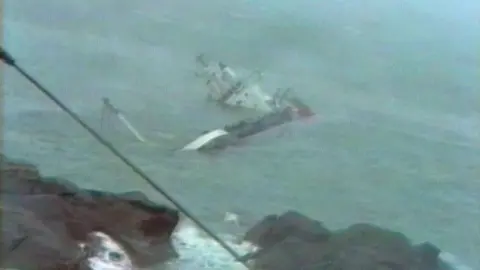
MV Cita, 26 March 1997, Newfoundland Point, Isles of Scilly
Described as the “wreck of the century” for the islanders, swathes of shipping containers washed ashore carrying all manner of cargo from gravestones to car engines and tobacco.
Rescuers estimated between 80 and 100 of the containers were adrift.
Despite efforts to pump the water out, the ship listed 60 to 70 degrees – seen at one point with only part of its wheelhouse out of the water.
The ship carried 30 tonnes of diesel creating an environmental problem.
Excitement over the salvage opportunities saw crowds arrive in the hope of securing some treasure.
MV Napoli, 18 January 2007, Branscombe
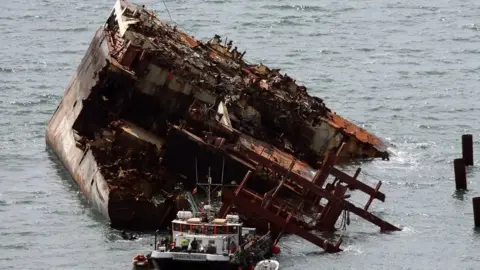
The most notable shipwreck of recent years, the 62,000-tonne vessel was badly damaged in a storm in the English channel on 18 January 2007 and started taking in water through a hole in its side before it ended up wrecking.
Heroic winchman, Jay O’Donnell, rescued the 26-strong crew, swimming through a 40ft swell to the ship’s lifeboat where the 26 crew had gathered and he winched them out one at a time.
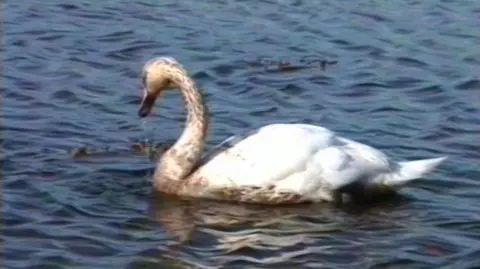
Up to 200 tonnes of oil leaked from the vessel leaving more than 1,600 birds covered.
Motorbikes, pet food, wine barrels and anti-wrinkle cream were among the varied items that washed up on Branscombe beach in Devon leading to scavengers raiding containers.
 Getty Images
Additional research by Mark Edwards.
